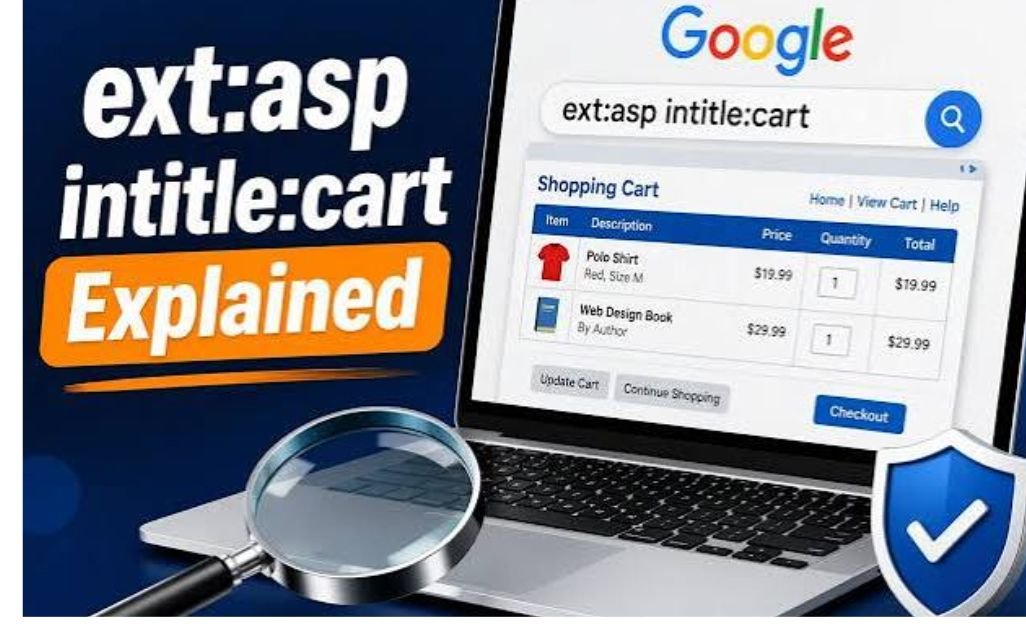
Ext:asp intitle:cart is an advanced search query used to find web pages associated with the ASP file extension and the word “cart” in their page titles. It belongs to a category of specialized search expressions commonly called Google dorks. These expressions combine search operators to narrow results and discover particular kinds of publicly indexed website content.
The query is especially associated with older e-commerce websites that use Classic ASP, a Microsoft server-side web technology. A result might be a shopping cart page, a store’s checkout-related page, or a technical document containing matching information. However, finding a page through search does not prove that it is insecure, outdated, or vulnerable.
Search engine reconnaissance is also discussed in the OWASP Web Security Testing Guide, which explains how publicly indexed information may reveal details about a website’s structure. Such research can help authorized security professionals and website owners understand information exposure.
In this guide, we explain what ext:asp intitle:cart means, how its operators work, why it appears in cybersecurity discussions, how Classic ASP relates to shopping carts, and how website owners can protect their online stores.
Quick Overview of Ext:asp Intitle:cart
| Detail | Information |
|---|---|
| Search Query | ext:asp intitle:cart |
| Type | Advanced search expression |
| Common Name | Google dork |
| First Operator | ext:asp |
| Second Operator | intitle:cart |
| File Extension | .asp |
| Main Keyword | cart |
| Related Technology | Classic ASP |
| Common Page Type | Shopping cart |
| Primary Purpose | Narrowing indexed search results |
| Security Application | Authorized information discovery |
| Hacking Tool | No |
| Proof of Vulnerability | No |
| Guaranteed Results | No |
| Search Engine Support | Varies |
| Related Google Operator | filetype: |
| Main Safety Concern | Unauthorized investigation |
| Current Relevance | Legacy website research and security awareness |
What Is Ext:asp Intitle:cart?
Ext:asp intitle:cart is a combination of two search filters.
The first part refers to the ASP extension.
The second part refers to the title of a webpage.
Together, they express a request to find pages that match both characteristics.
The query is associated with search engine reconnaissance, which involves examining information that search engines have already indexed.
It does not directly interact with a website’s database.
It does not log into an administrator account.
It does not bypass payment systems or reveal customer records by itself.
It is simply a search expression.
Why Is the Query Unusual?
Most internet users search by typing ordinary words or questions.
Advanced search operators work differently.
They allow users to specify particular characteristics of search results.
For example, a search engine may support filters based on file types, domains, or terms appearing in webpage titles.
Combining these filters produces more targeted results.
However, support for individual operators varies between search engines.
Google currently documents the filetype: operator, while ext: and intitle: have more variable support and behavior.
Therefore, the exact results of ext:asp intitle:cart are not guaranteed.
Breaking Down the Search Query
Understanding the two parts makes the expression easier to interpret.
What Does ext:asp Mean?
The expression ext:asp is commonly used to request results associated with the .asp file extension.
ASP stands for Active Server Pages.
Classic ASP is an older Microsoft technology that allows developers to generate dynamic webpages on a server.
A typical ASP page may receive information, process application logic, and produce HTML for a browser.
The .asp extension identifies the file type or application route in many older systems.
However, the extension alone does not reveal whether the application is secure.
What Does intitle:cart Mean?
The expression intitle:cart is intended to identify webpages containing the word “cart” in their titles.
Website titles help search engines understand page topics.
An online store might use titles such as “Shopping Cart,” “View Cart,” or “Your Cart.”
The operator is commonly described in advanced search documentation.
However, it is not part of Google’s small set of operators currently documented in its general public search help page.
Search behavior should therefore be tested carefully rather than assumed.
What Happens When Both Are Combined?
The intended result is a narrower collection of pages.
These pages would be associated with the ASP extension and include the word cart in their titles.
However, matching the expression does not establish that a result is a functioning shopping cart.
Search engines may return outdated, irrelevant, or partially matching pages.
They may also omit pages that technically fit the description.
What Is Classic ASP?
Classic ASP is a server-side scripting technology developed by Microsoft.
It became popular during the late 1990s and early 2000s.
Developers used it to build dynamic websites.
Unlike static HTML pages, ASP applications could process information and generate content based on user requests.
This made the technology useful for online stores, membership systems, and business websites.
How Classic ASP Works
A browser requests an ASP page from a server.
The server processes the relevant script.
It may communicate with databases or other application components.
The server then produces an HTTP response containing content for the browser.
The user normally sees the generated page rather than the original server-side script.
Why Did Online Stores Use ASP?
E-commerce applications require more than static pages.
They need to display products, calculate totals, manage shopping sessions, and process orders.
Classic ASP allowed developers to create these features.
As online shopping expanded, many businesses built stores using ASP-based systems.
Some continued operating those applications for many years.
Why Are ASP Shopping Cart Pages Important?
Shopping cart pages are important parts of an e-commerce website.
They allow customers to review selected products before completing an order.
A typical cart may display item names, quantities, prices, shipping estimates, and totals.
Because shopping carts interact with customer sessions and purchasing processes, they require appropriate security controls.
However, the page itself is usually intended to be accessible to customers.
This means finding a publicly visible shopping cart page is not automatically suspicious.
Public Pages Versus Private Information
A public shopping cart interface is different from a customer’s private order information.
An ordinary visitor may be allowed to view an empty cart page.
They should not be able to view another customer’s session or payment information.
That distinction is central to website security.
The existence of a search result does not tell an observer whether sensitive information is properly protected.
Is Ext:asp Intitle:cart a Google Dork?
Yes. It is commonly categorized as a Google dork.
Google dorking refers to using advanced search expressions to discover information through search engines.
The term may sound suspicious, but search operators have many legitimate uses.
Researchers, journalists, website owners, and security professionals use advanced searches to narrow publicly available information.
The ethical and legal questions depend on what a person does with the results.
Is Google Dorking the Same as Hacking?
No.
Searching publicly indexed information is not the same as breaking into a computer system.
However, information obtained through search can sometimes be misused.
For example, someone may discover that a website has unintentionally published sensitive information.
A responsible researcher should avoid accessing private data unnecessarily and should report genuine exposure through an appropriate channel.
Can Search Results Reveal Vulnerabilities?
Search results may provide clues about a website’s technology or publicly exposed content.
However, a clue is not proof of a vulnerability.
Determining whether a real weakness exists requires authorized assessment.
The query ext:asp intitle:cart does not independently establish a security problem.
Why Do Cybersecurity Professionals Discuss This Query?
Cybersecurity professionals study search engine exposure because websites sometimes publish information unintentionally.
Search engines may index public pages, documents, or older website content.
Some of that material may reveal details about an organization’s technical environment.
The OWASP Web Security Testing Guide discusses search engine reconnaissance as part of information gathering.
However, security professionals should conduct testing only within an authorized scope.
Understanding Public Exposure
Website owners should know which pages search engines can discover.
This helps them identify outdated content and unnecessary public information.
For an e-commerce business, the review may include shopping cart pages, product pages, and legacy application routes.
Recognizing Legacy Technology
Some businesses continue using older web technologies.
Older technology is not automatically insecure.
However, unsupported software may be harder to maintain safely.
Organizations should understand which technologies they use and whether updates and support remain available.
Improving Security Awareness
Search engine research can remind website owners that information intended to be private must be protected through real access controls.
Hiding a link from navigation is not sufficient protection.
Is Ext:asp Intitle:cart Dangerous?
The search expression itself is not dangerous.
It is a text query.
However, results should be handled responsibly.
A publicly indexed page may belong to a business that has not authorized external testing.
Attempting to bypass controls, manipulate transactions, or retrieve other users’ information can create legal and security problems.
Responsible Use
A legitimate use might involve examining a website that the researcher owns or is explicitly authorized to assess.
The objective should be understanding public exposure and improving defenses.
Unauthorized Testing
A search result is not an invitation to test a live website.
Website owners may restrict automated scanning, transaction testing, and other forms of technical interaction.
Permission should be established before conducting security assessments.
Why Do Some ASP Websites Still Exist?
Classic ASP has a long history.
Some businesses built important systems using it decades ago.
Replacing a working application can be expensive and complicated.
For this reason, older systems may remain in use.
Legacy Software
Legacy software refers to older technology that continues performing useful functions.
A business may rely on a legacy system because it supports established processes.
However, maintenance can become difficult as developers, hosting environments, and supporting components change.
Migration Costs
Moving an online store to a new platform may require redesigning databases, integrating payment services, and retraining employees.
These changes involve financial costs and operational risks.
Compatibility Requirements
Some businesses rely on custom functions developed for older applications.
Replacing them requires careful planning.
However, maintaining outdated technology without proper security support can create long-term problems.
Common Security Risks in Older E-Commerce Systems
An older shopping cart application can face the same general security concerns as any other web application.
The actual risk depends on its implementation, software maintenance, and configuration.
Outdated Components
Unsupported components may no longer receive security updates.
Organizations should maintain an inventory of their software.
They should also understand which parts still receive vendor support.
Weak Authentication
Administrative accounts require strong authentication controls.
Multi-factor authentication can provide additional protection where supported.
Account permissions should be limited to necessary functions.
Inadequate Access Controls
A secure application must prevent one customer from accessing another customer’s protected information.
Authorization checks should be enforced on the server.
Poor Session Management
Shopping sessions help an application recognize users and maintain cart information.
Secure session handling reduces the risk of unauthorized access.
Data Exposure
Customer information should be protected through appropriate storage and transmission security.
Sensitive payment information requires particular care.
Insufficient Monitoring
Organizations should monitor relevant application errors, security events, and unusual activity.
Monitoring helps teams detect issues and investigate incidents.
How Website Owners Can Protect Shopping Cart Pages
Website security requires more than preventing pages from appearing in search results.
The strongest protections operate at the application and server levels.
Keep Software Supported
Use maintained platforms and supported components whenever possible.
Plan migrations when critical technology reaches the end of its supported life.
Enforce Access Controls
Protect administrative functions and customer information through server-side authorization.
Public pages should not expose private session data.
Use Secure HTTPS Connections
HTTPS protects data during transmission between browsers and servers.
However, HTTPS does not guarantee that the application itself is secure.
Secure Payment Processing
Businesses should use appropriate payment processing services and follow relevant industry requirements.
Sensitive payment data should be handled carefully.
Review Search Indexing
Website owners should understand which pages search engines index.
Public product and information pages may be intended for discovery.
Private customer information should not be publicly accessible.
Test With Authorization
Regular authorized security assessments can identify issues before they become serious.
Organizations should define a clear testing scope.
Testing should avoid disrupting normal customer transactions.
Does Robots.txt Protect a Shopping Cart?
A robots.txt file provides instructions to search engine crawlers.
It can help manage crawling behavior.
However, it is not a security mechanism.
A URL disallowed through robots.txt may still be discoverable through external links.
More importantly, the file does not prevent an unauthorized person from visiting a publicly accessible page.
Sensitive information requires authentication, authorization, and appropriate server-side controls.
What About Noindex?
A noindex directive can instruct cooperating search engines not to include a page in their results.
However, it also does not function as an access-control mechanism.
A page can be excluded from search results while remaining accessible to anyone who knows its address.
Website owners should distinguish search visibility from security.
Ext:asp Intitle:cart and Search Engine Optimization
The query also has relevance to technical SEO.
Website owners may want to understand which pages appear in search engines.
Shopping carts and checkout pages are usually not useful landing pages for general search traffic.
They often contain content specific to an individual browsing session.
Why Shopping Cart Pages May Not Need Indexing
A shopping cart page usually does not provide substantial standalone information for searchers.
Its purpose is supporting a transaction.
For this reason, site owners often choose to prevent such pages from appearing in search results.
Indexing Strategy
An effective strategy distinguishes public product content from customer-specific transactional pages.
Product pages may benefit from search visibility.
Private account information must remain protected.
Checkout pages should be managed according to the site’s technical and business requirements.
SEO Is Not Security
Removing a page from search results does not fix an underlying access-control weakness.
Technical SEO and cybersecurity are separate disciplines with some overlapping concerns.
Limitations of the Ext:asp Intitle:cart Query
The query has several important limitations.
First, search engine operator support can change.
Second, search indexes are incomplete.
Third, a webpage title may not accurately describe its content.
Fourth, the ASP extension does not identify the full technology stack.
Finally, a result provides no reliable evidence about application vulnerability.
Search Results Can Be Outdated
Search engines may retain references to pages that have changed.
A listed URL may no longer work.
Not Every ASP Website Appears
Search engines do not index every website or application route.
Some pages require authentication.
Others may be excluded from crawling.
False Positives
Some results may contain the word cart without operating as shopping carts.
Others may discuss ASP rather than use the technology.
This makes manual interpretation important.
Ext:asp Intitle:cart Compared With Other Search Operators
Advanced search operators serve different purposes.
| Operator | General Purpose |
|---|---|
| ext: | File-extension filtering in engines that support it |
| intitle: | Search for a term in a page title |
| filetype: | Search for a specified file type |
| site: | Restrict results to a particular website or domain |
| “Exact phrase” | Look for a particular phrase |
| -keyword | Exclude a term from search results |
Support varies by search engine.
Google officially documents filetype: and site: among its general search refinement options.
The exact behavior of other operators should not be assumed to remain constant.
Why Is Ext:asp Intitle:cart Popular Online?
The expression attracts attention because it looks technical.
People unfamiliar with search operators may assume it represents a special hacking command.
Cybersecurity discussions also use similar expressions when explaining search engine reconnaissance.
As a result, the phrase appears in technical articles, forums, and educational websites.
Curiosity About Google Dorks
Google dorking is a recognizable topic within cybersecurity education.
People may search for particular expressions to understand how search engines interpret them.
Interest in Older E-Commerce Platforms
Classic ASP shopping carts are connected with an earlier era of online commerce.
Researchers may encounter the technology while learning about legacy applications.
Confusion About Security
Some articles describe search expressions in dramatic language.
However, discovering a webpage is not equivalent to compromising it.
Understanding that distinction is essential.
Is Ext:asp Intitle:cart Still Relevant in 2026?
The expression remains useful as an educational example of advanced search syntax.
However, its results depend on current search engine support.
Classic ASP also continues to appear in discussions about legacy systems.
Organizations that operate older applications should understand their maintenance requirements.
The broader lesson is more important than the exact query.
Publicly indexed information can reveal details about a website.
Website owners should protect sensitive resources through proper controls rather than relying on obscurity.
Interesting Facts About Ext:asp Intitle:cart
- It is an advanced search expression.
- It combines two search filters.
- The
ext:portion refers to file extensions. - ASP stands for Active Server Pages.
- The
intitle:portion relates to webpage titles. - The word cart commonly appears in online shopping pages.
- Classic ASP was popular in early dynamic websites.
- The query is often categorized as a Google dork.
- Google dorking is not automatically malicious.
- Search engine operator support varies.
- Google officially documents the
filetype:operator. - Search results do not prove vulnerabilities.
- A shopping cart page may be intentionally public.
- Customer data requires separate access protection.
- Robots.txt is not a security control.
- Noindex does not replace authentication.
- Older e-commerce systems may remain in use for business reasons.
- Authorized testing can help organizations identify exposure.
- Search indexes may contain incomplete or outdated information.
- Website security depends on implementation, not simply file extensions.
Frequently Asked Questions About Ext:asp Intitle:cart
1. What does ext:asp intitle:cart mean?
It is a search expression intended to find pages associated with the ASP extension and the word cart in their titles.
2. Is ext:asp intitle:cart a Google dork?
Yes. It is commonly described as a Google dork because it combines advanced search operators.
3. What does ext:asp mean?
It refers to pages or files associated with the .asp extension in search engines supporting that operator.
4. What does intitle:cart mean?
It is intended to find webpages with the word cart in their titles.
5. What is ASP?
ASP stands for Active Server Pages, a Microsoft server-side scripting technology.
6. Is Classic ASP still used?
Some older web applications continue using Classic ASP.
7. Does the query hack websites?
No. The expression itself is a search query.
8. Can it reveal passwords?
The query is not designed to retrieve passwords and does not establish access to private information.
9. Does finding an ASP cart mean the website is vulnerable?
No. The file extension and page title do not establish a security weakness.
10. Is Google dorking illegal?
Using public search tools is generally a normal activity, but accessing protected resources or conducting unauthorized testing can violate laws and policies.
11. What is a shopping cart page?
It is a webpage where customers review selected products before completing a purchase.
12. Why do shopping cart pages use ASP?
Some older e-commerce applications were developed using Classic ASP.
13. Is ASP the same as ASP.NET?
No. Classic ASP and ASP.NET are different Microsoft web development technologies.
14. Is ext: an official Google operator?
Its general Google Search support is not currently documented in the same way as filetype:.
15. What does filetype: do?
It is a documented Google operator used to filter results by file type.
16. Can the query find every ASP cart page?
No. Search indexes are incomplete, and operator behavior can vary.
17. What is search engine reconnaissance?
It involves examining publicly indexed information to understand what can be discovered about a website or organization.
18. Why do security researchers use search operators?
They can help identify publicly exposed information during authorized investigations.
19. Can robots.txt secure a shopping cart?
No. Robots.txt provides crawler instructions rather than access protection.
20. Does noindex protect customer data?
No. Noindex controls search visibility and does not replace authentication or authorization.
21. Should shopping cart pages appear in Google?
Many businesses prefer not to index customer-specific transactional pages, but the correct approach depends on the application.
22. What is a legacy website?
It is a website that continues using older technologies or components.
23. Are all legacy websites insecure?
No. Security depends on maintenance, configuration, and implementation.
24. Is ext:asp intitle:cart useful for SEO?
It can illustrate search filtering, but reliable technical SEO requires more comprehensive website auditing.
25. What is the most important fact about this query?
A search result is not proof of vulnerability, and security testing should be performed only with authorization.
Final Thoughts
Ext:asp intitle:cart is an advanced search expression associated with Classic ASP shopping cart pages.
Its first component attempts to filter results by file extension.
Its second component focuses on webpage titles containing the word cart.
Together, these filters can help explain how specialized search expressions work.
However, search results are neither complete nor guaranteed to be precise.
The query is often discussed within Google dorking and cybersecurity education.
That does not mean using it automatically identifies vulnerable websites.
A public shopping cart page may be operating exactly as intended.
Real security depends on protecting customer data, maintaining software, enforcing access controls, and conducting authorized testing.
Website owners should also understand the difference between search indexing and access protection.
Preventing a page from appearing in search results does not automatically make it secure.
Ultimately, ext:asp intitle:cart is most useful as an example of how search engines can reveal public information about older web technologies.
Understanding its limitations helps readers approach cybersecurity with greater accuracy and responsibility.
For more technology guides, cybersecurity education, business insights, and informative articles, visit Villy Magazine.
SEO Meta Description: Learn what ext:asp intitle:cart means, how its search operators work, its connection to Classic ASP shopping carts, and important website security tips.